
French Bulldog & Pug DNA Testing and Health Genetics
DNA should be a part of a responsible French Bulldog and Pug breeders health testing programme. It helps breeders understand inherited disease markers, carrier status, parentage, colour and coat genetics, and genetic diversity where available.
At Le Epitome Kennels, DNA results are used as breeding information, not as a marketing slogan. A clear DNA profile does not automatically make a dog suitable for breeding, and a carrier result does not automatically make a dog unhealthy.
DNA testing must be read alongside the living dog. Breathing, structure, movement, patellas, spine, hips, temperament, fertility, whelping history, veterinary feedback, family history and long-term outcomes all matter.
This page explains what DNA testing can tell us, what it cannot tell us, how colour and health DNA differ, how clear/carrier/affected results should be understood, and how DNA information is used when planning French Bulldog and Pug pairings.
The redacted DNA profile examples on this page are included for education and transparency. They show the kind of information that may appear on a DNA report, while protecting private details such as owner information, microchip numbers, laboratory references, certificate numbers, barcodes and account details.
A Note on Breed Health Risk
This page discusses DNA testing, inherited disease markers and health genetics in French Bulldogs and Pugs. Reading about health risks can feel confronting, but the purpose is education, not alarm.
Not every dog will develop the conditions discussed on this page. DNA testing helps breeders understand known genetic risks, avoid preventable carrier-to-carrier pairings, plan more responsibly, and make better long-term breeding decisions.
Published breed-health information usually reflects the wider population of dogs seen by veterinarians, including dogs from many different sources. It should not be treated as a guarantee about any individual puppy or breeding programme.
DNA testing is useful, but it is only one layer. Responsible breeding still needs physical health assessment, veterinary care, breathing and movement review, temperament assessment, reproductive history, puppy observation and long-term feedback.
Why DNA Testing Matters
DNA testing gives breeders information that cannot always be seen by looking at a dog. A French Bulldog or Pug may appear healthy, typical and well-structured, while still carrying recessive genetic variants that could matter in future breeding decisions.
This is especially important in specialist companion breeds where health, breathing, structure, temperament and long-term soundness need to stay ahead of appearance, colour or pedigree alone.
DNA testing can help identify inherited disease markers, carrier status, parentage, colour and coat traits, and genetic diversity where available. This information helps breeders understand what a dog expresses, what it carries, and how it may complement or conflict with another dog in a planned mating.
One of the most important uses of DNA testing is avoiding preventable carrier-to-carrier pairings for the same recessive condition. A carrier dog is not automatically unhealthy, but carrier status must be understood and managed responsibly.
DNA testing is also useful when introducing new bloodlines, outside studs, imported semen, coloured lines or fluffy lines. It reduces guesswork and helps ensure breeding decisions are based on information rather than assumption.
DNA testing does not replace physical health assessment. It is one layer of a responsible breeding programme, used alongside veterinary care, breathing and movement assessment, patella and structure review, reproductive history, temperament, bloodline knowledge and long-term feedback.
What DNA Testing Can Tell Us
DNA testing can reveal information that is not always visible from appearance alone. It can help breeders understand inherited disease markers, carrier status, parentage, colour and coat traits, and genetic diversity where available.
For inherited disease screening, DNA testing can show whether a dog is clear, a carrier, or genetically affected for specific testable conditions. This is useful because many recessive variants can be carried silently without the dog showing signs of disease.
For parentage, DNA testing can help confirm identity and relationships between dogs. This is especially useful where accurate pedigree, imported semen, outside studs or retained breeding prospects are involved.
For colour and coat traits, DNA testing can show what a dog expresses and what it carries. In French Bulldogs and Pugs, this may include genes linked to fawn, sable, tan point, recessive black, brindle, pied, blue, chocolate, cocoa, lilac, Isabella, rojo, mask, cream and fluffy coat.
For genetic diversity, some DNA reports may provide information such as heterozygosity or diversity measures. These results can help breeders think about how genetically similar or varied dogs may be, although they should be interpreted alongside pedigree, health, structure, temperament and breeding goals.
DNA testing gives breeders a clearer map before making breeding decisions. It reduces guesswork, helps avoid preventable inherited-disease risks, and supports more informed pairing decisions.
What DNA Testing Cannot Tell Us
DNA testing is valuable, but it does not assess the whole dog.
A DNA report can identify known testable variants, carrier status, parentage, colour and coat traits, and genetic diversity where available. It cannot tell us how comfortably a dog breathes, how well it moves, how strong its rear end is, how the patellas track, how the spine functions, how the dog copes with heat, or how it recovers after activity.
DNA testing also cannot fully assess temperament, confidence, fertility, natural mating ability, whelping ability, maternal behaviour, skin resilience, eye comfort, heart function or general robustness in daily life.
This is especially important in French Bulldogs and Pugs because many of the most important health considerations are physical and functional. BOAS, nostril openness, airway function, patella stability, movement, hip structure, spine comfort, body condition and reproductive soundness cannot be cleared by a DNA report alone.
A dog can have excellent DNA results and still be unsuitable for breeding if it has poor breathing, weak structure, poor movement, unstable temperament, significant veterinary concerns or poor reproductive function.
For this reason, DNA testing should be read alongside physical health assessment, veterinary examination, breeding history, puppy development, owner feedback and long-term knowledge of the line. It is an important layer of responsible breeding, but it is not the whole health picture.
Health DNA Testing and Inherited Disease Screening
Health DNA testing looks for specific inherited disease variants that are known, testable and relevant to the breed or breeding programme.
Most DNA health results are reported in simple categories such as clear, carrier or affected. These categories are useful, but they need to be understood correctly.
A clear result usually means the tested variant was not detected in that dog.
A carrier result usually means the dog has one copy of a recessive variant. A carrier dog is not usually affected by that recessive condition, but the result matters for breeding because the variant can be passed on.
An affected or at-risk result means the dog has inherited the variant in a way that may cause disease, or may increase the dog’s risk of developing the condition, depending on the condition and the type of test.
Carrier status is one of the most commonly misunderstood parts of DNA testing. A carrier dog is not automatically unhealthy, and a carrier result does not automatically remove a dog from a responsible breeding programme. What matters is how that information is used.
For recessive conditions, the main risk usually comes from pairing two dogs that carry the same condition. If two carriers are bred together, there may be a risk of producing affected puppies. DNA testing helps breeders avoid those preventable pairings.
Health DNA testing is therefore most useful when it changes breeding decisions. It helps breeders identify risk, choose suitable pairings, avoid affected puppies where possible, and keep useful dogs in the gene pool without ignoring known genetic information.
Inherited disease screening should still be read alongside the whole dog. DNA results do not replace breathing assessment, movement assessment, patella checks, spine and hip review, temperament assessment, reproductive history, veterinary findings or long-term feedback from related dogs.
Colour DNA Testing vs Health DNA Testing
Not all DNA testing answers the same question. In dog breeding, DNA testing may be used for inherited disease screening, colour and coat testing, parentage verification, breed-relevant markers and genetic diversity information.
Health DNA testing looks for specific inherited disease variants. These results help breeders understand whether a dog is clear, a carrier or affected for particular testable conditions, and whether a planned pairing could create avoidable risk.
Colour DNA testing looks at genes connected with coat colour and coat type. In French Bulldogs and Pugs, this may include traits such as fawn, sable, tan point, recessive black, brindle, pied, blue, chocolate, cocoa, lilac, Isabella, rojo, mask, cream and fluffy coat.
Colour DNA testing can be useful. It helps breeders understand what a dog expresses, what it carries, and what colours or coat types may be possible in a litter. It is especially useful when working with coloured lines, fluffy lines, outside studs, imported semen or dogs whose visual colour may not tell the whole genetic story.
However, colour DNA is not the same as health testing. A dog may have a rare or desirable colour profile and still be unsuitable for breeding if it has poor breathing, weak movement, unstable patellas, poor structure, significant health concerns, poor temperament or poor reproductive function.
The opposite is also true. A dog with a simple or common colour may be extremely valuable because of its health, temperament, structure, movement, fertility, maternal ability, genetic diversity or contribution to the wider programme.
Colour and coat results should be understood and recorded, but they should not lead the breeding decision. Health, function, temperament and long-term soundness must carry more weight than colour.
Genetic Diversity, Inbreeding and Breeding Decisions
DNA testing can also help breeders think about genetic diversity. Genetic diversity matters because a breeding programme should not only avoid known inherited disease variants; it should also consider how much genetic variety is being preserved over time.
In dog breeding, genetic diversity may be discussed through terms such as heterozygosity, genetic diversity scores, genomic diversity or coefficient of inbreeding. These tools do not make breeding decisions by themselves, but they can help breeders understand whether a planned mating may increase or reduce genetic variety.
Low genetic diversity does not automatically mean a dog is unhealthy, and higher diversity does not guarantee perfect health. These results need to be interpreted alongside the dog’s breed type, health, structure, temperament, breathing, movement, fertility, maternal ability and family history.
Genetic diversity also needs balance. Preserving diversity does not mean breeding randomly, ignoring breed type, or using unsuitable dogs simply because they are different. It means making thoughtful decisions so that useful genes are not lost unnecessarily and the programme does not become too narrow over time.
This matters especially when working with specialised lines, rare colours, fluffy lines, imported semen or heavily used popular sires. If the same related dogs are used too often, the gene pool can narrow and hidden risks may become harder to manage.
For responsible breeding, diversity information should be one part of the wider decision. A breeding dog should not be selected only because it has a rare colour, a fashionable pedigree or one good DNA result. The better question is what the dog contributes to the future of the programme as a whole.
At Le Epitome Kennels, genetic diversity is considered alongside DNA health results, physical health, breathing, structure, movement, temperament, reproductive soundness, pedigree knowledge and long-term outcomes from the dogs we place.
DNA Profile Examples From Our Programme
We believe DNA testing should be more than a phrase on a website. Where appropriate, we provide redacted examples of DNA profiles from dogs in our programme to help buyers understand what DNA testing can show and how those results are used.
These examples are provided for education and transparency. They may include inherited disease results, carrier status, colour and coat genetics, parentage information, genetic diversity information or breed-relevant markers, depending on the laboratory and test panel used.
Before any DNA profile is published, private and identifying details should be removed. This may include owner information, addresses, phone numbers, email addresses, microchip numbers, certificate numbers, laboratory reference numbers, sample IDs, QR codes, barcodes, account details and any other private administrative information.
The examples on this page include DNA profile information from dogs such as Bailey, a former dam in our programme, Chocoholic, Moby’s sire, and Mona, Moby’s dam. These profiles are not published to compare dogs against each other. They are included to show how DNA information can help explain inherited disease status, colour genetics, carrier status and breeding decisions.
A DNA profile should not be read as a complete health assessment of the dog. It is one layer of information. Each report still needs to be interpreted alongside the dog’s breathing, structure, movement, temperament, veterinary history, reproductive history, family line and long-term outcomes.
For buyers, the useful lesson is not just what one dog’s DNA says. The useful lesson is how a breeder reads the result, records it, protects private information, and uses it to make more informed breeding decisions.
How DNA Results Are Used When Planning Pairings
DNA results help breeders understand how two dogs may work together genetically before a mating is planned.
For inherited disease screening, the key question is whether both dogs carry the same recessive condition. A carrier dog can still be a healthy and valuable breeding dog, but it must be paired responsibly. If two dogs carry the same recessive condition, there may be a risk of producing affected puppies.
For breed-relevant markers, DNA results may also help identify information connected with spinal structure, coat type, airway-risk markers, or other traits that need to be interpreted carefully. These markers should not be treated as a complete prediction of the dog’s health, but they can still provide useful breeding information.
For colour and coat traits, DNA results help explain what colours or coat types may be possible in a litter. This is useful for planning, but it should not decide a pairing on its own. A colour outcome may be interesting, but the overall health, temperament, structure and suitability of the dogs matter more.
For genetic diversity, DNA information may help breeders avoid repeatedly narrowing the gene pool. This can be especially useful when working with specialised lines, rare colours, fluffy lines, imported semen, outside studs or dogs that may share related ancestry.
A good pairing is not simply two dogs with attractive DNA reports. It should consider the whole picture: inherited disease status, carrier status, physical health, breathing, movement, patellas, hips, spine, temperament, reproductive history, family history, genetic diversity and the strengths and weaknesses of both dogs.
At Le Epitome Kennels, DNA results are used to reduce guesswork, avoid preventable risk, manage carrier status responsibly, understand colour and coat genetics, and plan pairings with the long-term programme in mind.
How to Read Our DNA Profile Examples
A DNA profile can look technical at first, but most of the information becomes easier to understand when it is separated into categories.
Health results usually show whether a dog is clear, a carrier, affected, or at increased genetic risk for specific testable conditions.
A clear result means the tested variant was not detected.
A carrier result usually means the dog has one copy of a recessive variant. The dog is not usually affected by that condition, but the result matters for breeding because the variant can be passed on.
An affected or at-risk result means the dog has inherited the variant in a way that may cause disease or increase risk, depending on the condition and the type of test.
Colour and coat results explain what the dog expresses and what the dog may carry. These results may include genes linked to fawn, sable, tan point, recessive black, brindle, pied, mask, cream, blue, chocolate, cocoa, lilac, Isabella, rojo or fluffy coat.
Genetic diversity results, where available, help show how genetically varied a dog is. These results can be useful for long-term breeding decisions, but they are only one part of the wider picture.
Breed-relevant markers, such as DVL2, ADAMTS3, CDDY or CDPA where included, should be read carefully. These markers may give useful information, but they do not replace physical health assessment, movement observation, veterinary examination or breeding history.
When reading any DNA profile, the most important question is not simply “what does this result say?” The better question is: “how should this result affect breeding decisions?”
The value of DNA testing is in interpretation. A responsible breeder should understand what the result means, record it properly, protect private information, and use the information to reduce avoidable risk over time.
Redacted DNA Profile Examples From Our Programme
The following examples show the type of DNA information used when assessing and planning breeding dogs. These are redacted examples, with private details removed before publication.
A DNA report may include inherited disease results, colour and coat genetics, parentage information, breed-relevant markers and genetic diversity information, depending on the laboratory and panel used.
These examples should not be read as a complete health assessment of any dog. DNA testing is one layer of information. Breathing, movement, structure, temperament, veterinary history, reproductive history and long-term outcomes still matter.
The examples on this page include DNA profile information from dogs such as Bailey, a former dam in our programme; Chocoholic, Moby’s sire; Mona, Moby’s dam; and Moby.
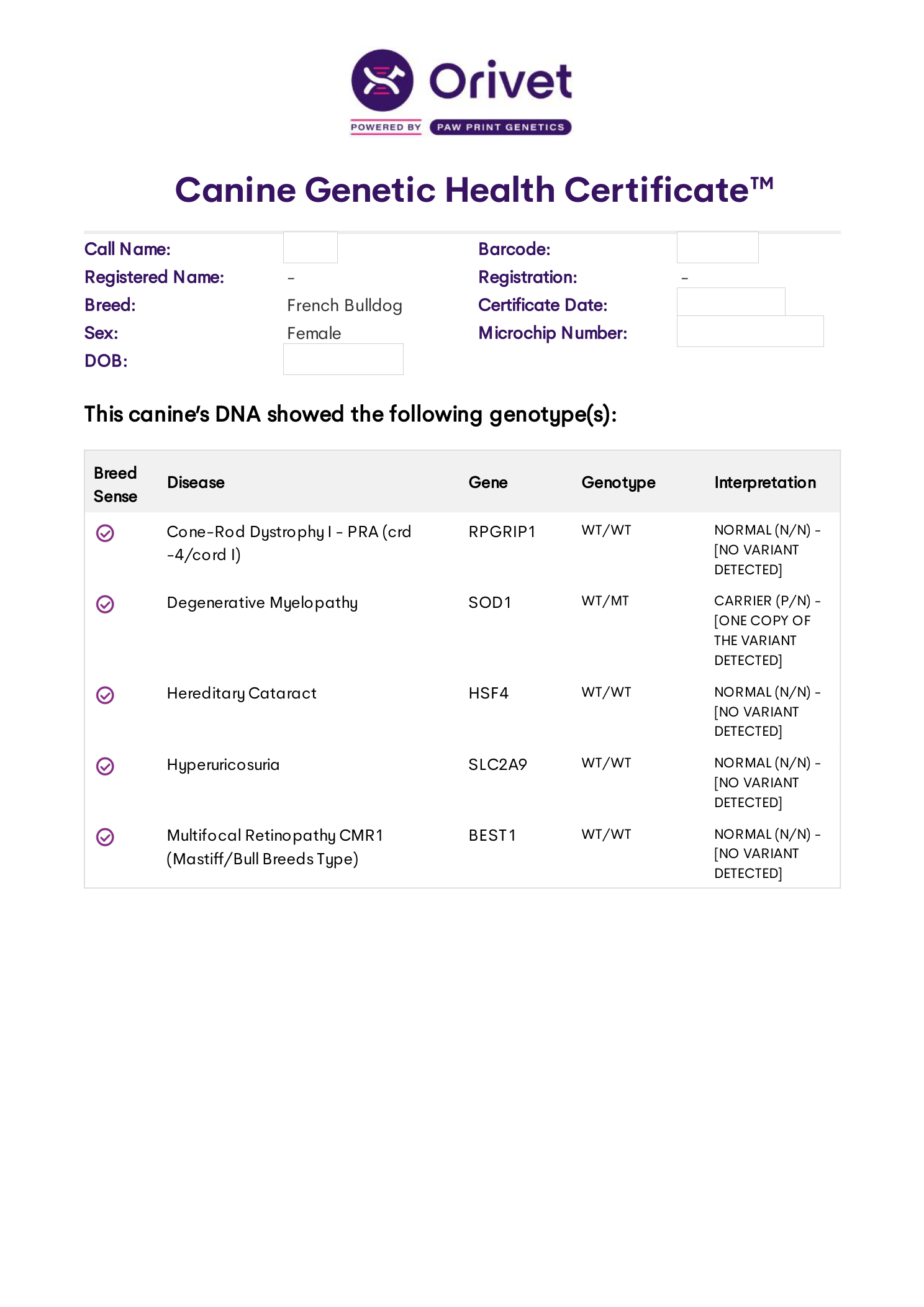
Redacted DNA profile example — Bailey, former French Bulldog dam
Bailey’s DNA profile shows why carrier status needs to be understood properly. She was identified as a Degenerative Myelopathy carrier, which does not make her unhealthy, but it does mean she needed to be paired only with a clear/non-carrier dog for that condition.
Example 1 — Bailey, Former French Bulldog Dam
Bailey’s redacted DNA profile is useful because it shows how carrier status should be understood.
Her report identified her as a carrier for Degenerative Myelopathy. A carrier dog is not automatically unhealthy. The important breeding question is whether that carrier status is recorded and managed responsibly.
In practical breeding terms, a dog carrying one copy of a recessive condition should not be paired with another dog carrying the same condition. Pairing a carrier with a clear/non-carrier dog can avoid producing affected puppies for that condition.
Bailey is now retired from our breeding programme. Her retained replacement offspring have been DNA tested and are not carriers for Degenerative Myelopathy. This is a practical example of DNA testing being used to make better decisions over time.
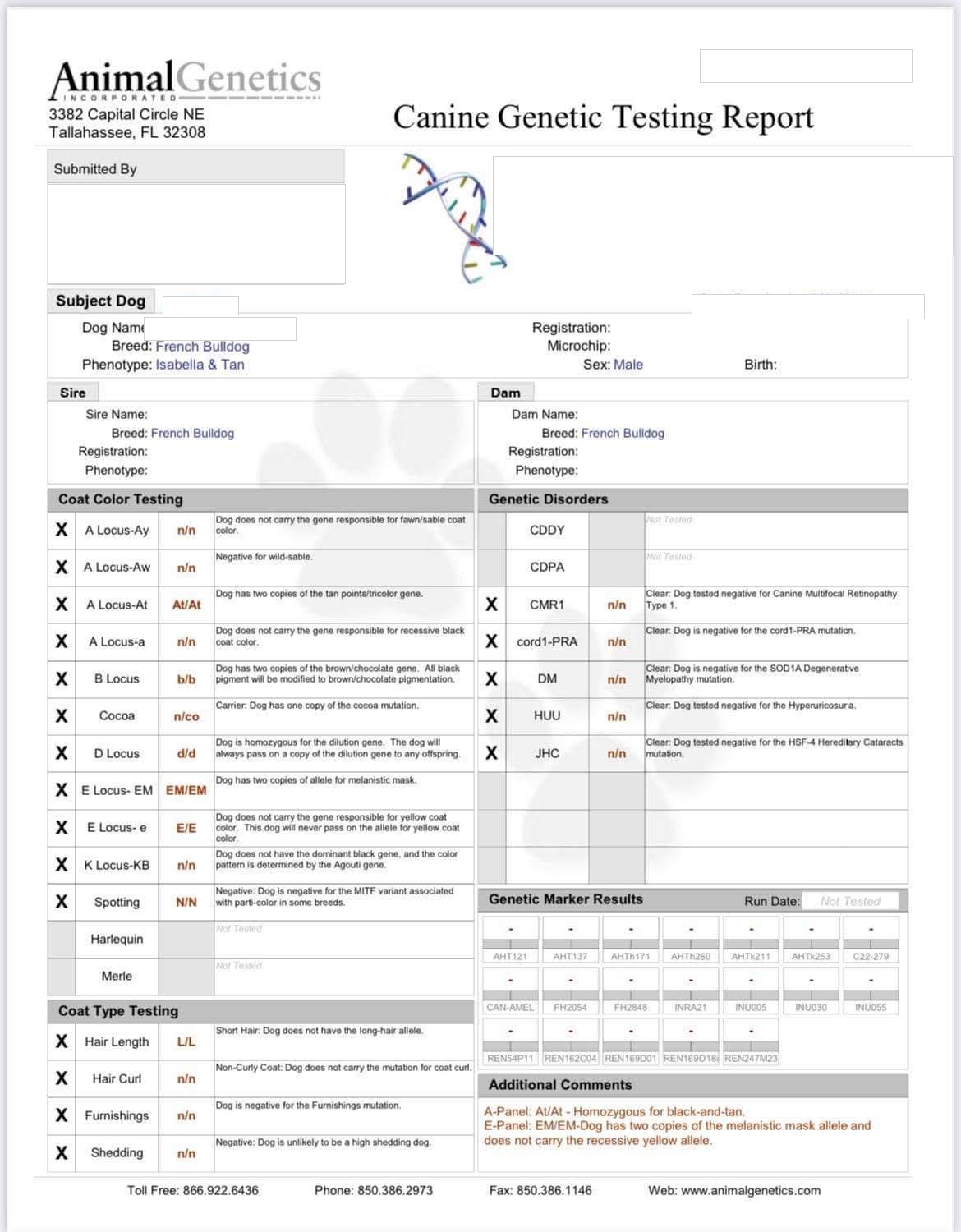
Redacted DNA profile example — Chocoholic, sire of Moby
Chocoholic’s DNA profile helps show how colour genetics and health DNA can appear together on a report. His profile supports his Isabella and tan colouring, while also showing why colour DNA should be read separately from inherited-disease health testing.
Example 2 — Chocoholic, Sire of Moby
Chocoholic’s redacted DNA profile is useful because it shows how colour genetics and health genetics can appear together on a report.
His profile includes information relevant to Isabella and tan colouring, including tan point, testable chocolate/brown, cocoa carrier status, dilution and other coat-colour markers.
This example helps show that colour descriptions such as Isabella and tan are not based on one gene alone. They are created by several coat-colour results working together.
His report also shows the value of checking whether inherited disease markers were tested and what the result was. Colour information is useful, but colour DNA is not the same as health testing.
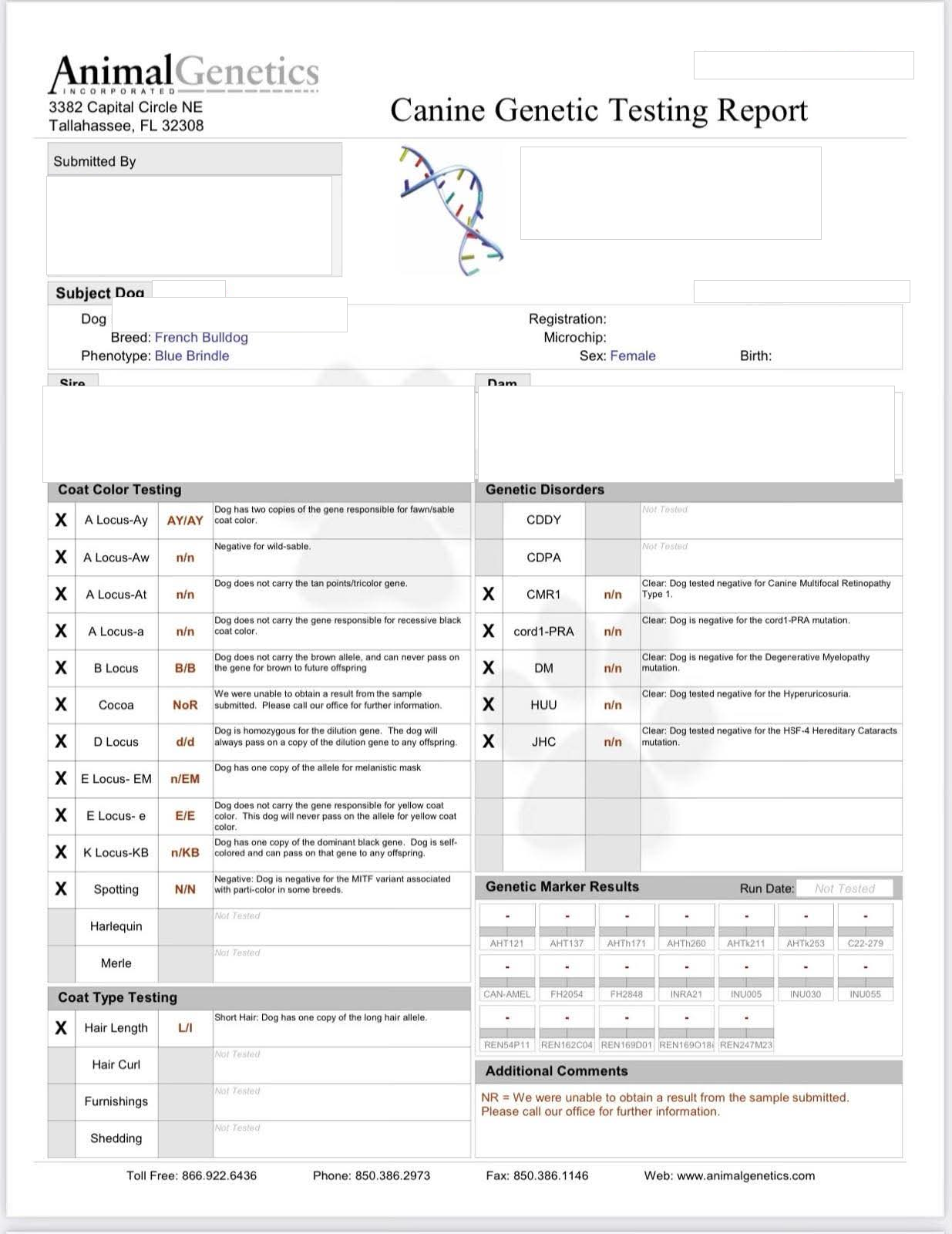
Redacted DNA profile example — Mona, dam of Moby
Mona’s DNA profile is useful because a parent’s DNA results can help explain what may be passed to the next generation. Parent results support better pairing decisions, clearer record keeping, and clear-by-parentage logic where the relevant tests and parentage are properly recorded.
Example 3 — Mona, Dam of Moby
Mona’s redacted DNA profile is useful because it shows how a dam’s DNA information can help inform the next generation.
Her report should be read alongside Moby’s profile and the wider breeding record. Parent results help explain what traits may be passed on, what risks need to be managed, and what results should be checked in retained offspring or future breeding dogs.
This example helps show why a DNA report is not only about the individual dog being tested. In a breeding programme, a parent’s DNA profile can help explain offspring results, support clear-by-parentage logic where appropriate, and guide future pairing decisions.
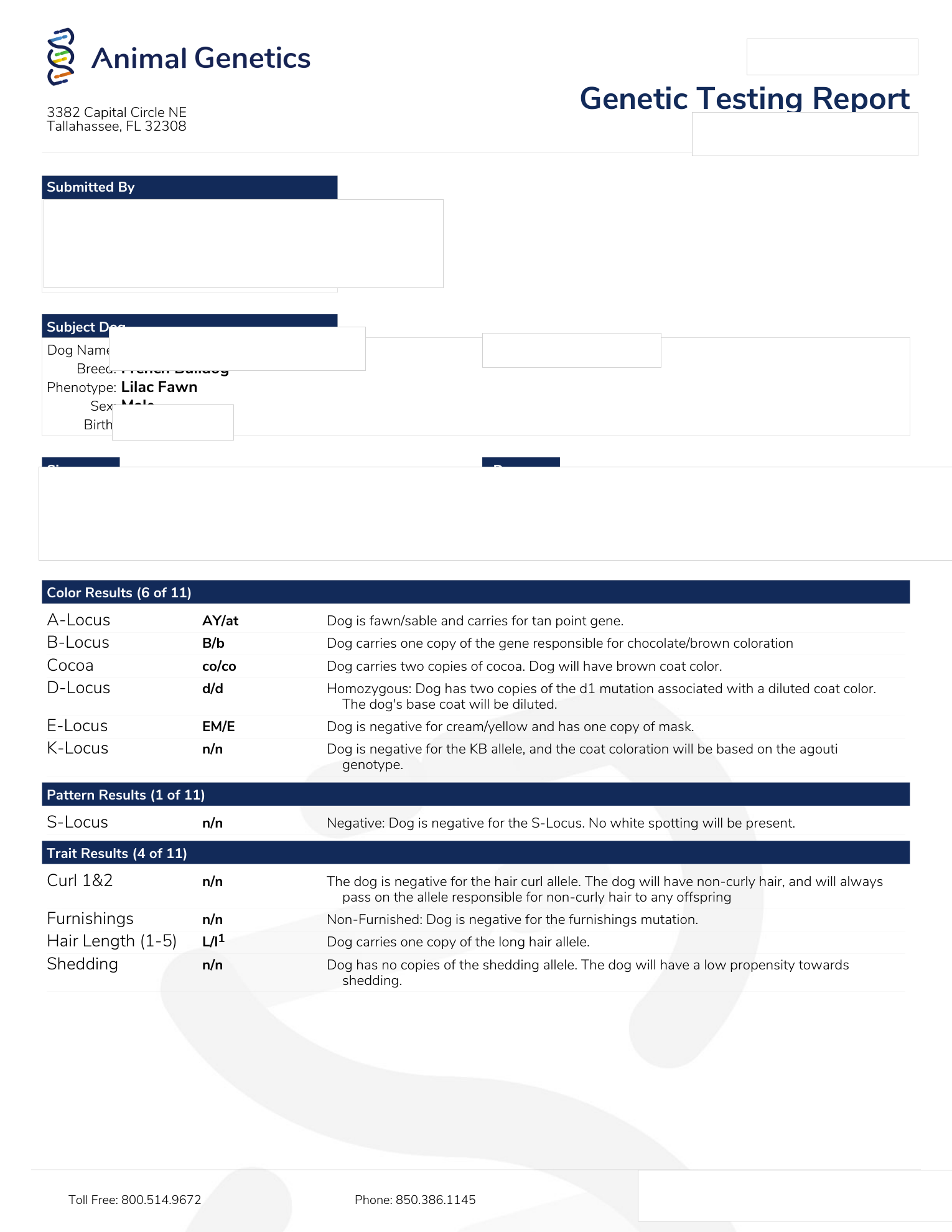
Redacted DNA profile example — Moby / Mr Austin, lilac fawn French Bulldog and fluffy carrier
Moby’s report shows a lilac fawn colour profile and one copy of the long-coat / fluffy marker. It is a good example of a colour and trait DNA report: useful for understanding what a dog expresses and carries, but not a complete health assessment by itself.
Example 4 — Moby, Lilac Fawn and Fluffy Carrier Profile
Moby’s redacted Animal Genetics report is useful because it shows how a colour and coat DNA profile can support breeding decisions without being treated as the whole health picture.
The report identifies Moby, also recorded as Mr Austin / Green Collar, as a French Bulldog male with a lilac fawn phenotype. His colour and coat results include fawn/sable carrying tan point, one copy of testable chocolate/brown, two copies of cocoa, two copies of dilution, one copy of mask, negative dominant black, no MITF-associated white spotting, and one copy of the long-coat / fluffy marker.
This explains why Moby can appear as a short-coated lilac fawn dog while still carrying genetics that matter for future colour and coat planning. In particular, his long-coat result shows that he is a fluffy carrier, even though he is not visually fluffy.
Moby’s report is also a useful example of why colour DNA and health DNA need to be kept separate. This particular report is mainly a colour and trait profile. It helps explain what Moby expresses and carries, but it should not be read as a complete inherited-disease health certificate by itself.
The wider health context comes from the breeding records around him. Where both parents are clear for relevant inherited conditions, a dog may be clear by parentage for those conditions, provided the parentage and test results are known and recorded. Where retained offspring or progeny are later DNA tested clear for relevant markers, that gives further practical confirmation that the breeding information is being used and checked over time.
Moby’s example is useful because it shows several layers working together: colour and coat DNA, parent information, clear-by-parentage logic where supported by records, and later testing of retained or related offspring. This is how DNA information should be used in practice — not as one isolated certificate, but as part of a recorded breeding programme.
How These Examples Should Be Read
These examples are included to help buyers understand how DNA testing is used in real breeding decisions.
The key lesson is not that one dog’s report is “good” or “bad.” The key lesson is that DNA results need to be recorded, understood and acted on.
A carrier result may require a careful pairing. A colour result may explain what a dog expresses or carries. A missing test may show that the report should be updated before future breeding decisions. A parentage result may support clear-by-parentage logic where the parent tests and parentage are properly recorded. A clear result in retained or related offspring can help confirm that testing is being used across generations.
Good DNA testing is not just having certificates. It is understanding what the results mean and using them to reduce avoidable risk over time.
Genetic Conditions We Screen For and How We Manage Risk
The conditions listed below are examples of inherited disorders that may appear on French Bulldog DNA health panels or in the redacted DNA reports shown on this page. Not every laboratory tests for the same conditions, and not every report includes every test as some tests are new.
Cone-Rod Dystrophy / Progressive Retinal Atrophy
Cone-Rod Dystrophy is a form of Progressive Retinal Atrophy, often shortened to PRA. It affects the retina at the back of the eye, where light is processed for vision. In affected dogs, retinal cells can degenerate over time, leading to signs of retinal disease or progressive vision loss.
In DNA testing, this condition may appear under names such as cord1-PRA, crd4/cord1, Cone-Rod Dystrophy or RPGRIP1, depending on the laboratory.
How we manage it:
We use DNA results to identify whether a dog is clear, a carrier or genetically at risk. If a dog is a carrier, it should only be paired with a clear/non-carrier dog for that condition so affected puppies are not produced.
Degenerative Myelopathy
Degenerative Myelopathy, often shortened to DM, is associated with degeneration of the spinal cord. It is usually discussed as an adult-onset neurological condition that can affect hind-leg coordination and may progress over time.
The common DNA test looks at a variant in the SOD1 gene. A carrier dog is not expected to develop DM from one copy of this variant alone, but two copies may place a dog at increased genetic risk.
How we manage it:
Carrier status is recorded and used when planning pairings. A DM carrier can still be bred responsibly, but should be paired with a clear/non-carrier dog so puppies are not produced with two copies of the risk variant.
Hereditary Cataract
Hereditary Cataract testing looks for inherited variants associated with cataract development. Cataracts cause clouding of the lens of the eye and can interfere with vision. In some inherited forms, cataracts can develop young and may progress.
In French Bulldogs, hereditary cataract testing is commonly associated with the HSF4 gene on DNA reports.
How we manage it:
We use DNA screening to identify clear, carrier or affected results where this test is included. Dogs carrying a recessive cataract variant should be paired only with a clear/non-carrier dog for that condition.
Hyperuricosuria
Hyperuricosuria, often shortened to HUU, affects how uric acid is processed and excreted. Affected dogs can have elevated uric acid in the urine, which may increase the risk of urate bladder or kidney stones.
This condition is commonly associated with the SLC2A9 gene and is inherited in a recessive manner.
How we manage it:
DNA testing helps identify clear, carrier and affected results. A carrier dog is not expected to show disease from one copy of the variant alone, but carrier-to-carrier pairings should be avoided so affected puppies are not produced.
Cystinuria Type III and Cystine Stone Risk
Cystinuria is a condition where cystine can build up in the urine and form cystine crystals or urinary stones. In dogs, this can lead to urinary discomfort, straining, blood in the urine, repeated urinary issues, or, in serious cases, urinary obstruction.
Cystinuria Type III is particularly important to interpret carefully because genetic risk information does not always behave like a simple “this dog will or will not get the disease” result. It should be treated as breeding-risk information and interpreted alongside the dog’s sex, veterinary history, urinary health, family history and the specific laboratory result.
For breeding decisions, the practical aim is to avoid increasing the risk of producing dogs that may develop cystine stone disease. Where Cystinuria Type III is included on a DNA panel, the result should be recorded, reviewed and considered before breeding.
As with other DNA-linked conditions, a DNA result should not be turned into a disease-prevalence claim unless there is reliable clinical presentation data. Carrier or marker information is not the same as the number of dogs that actually develop urinary stones.
Canine Multifocal Retinopathy CMR1
Canine Multifocal Retinopathy 1, often shortened to CMR1, is an inherited eye condition associated with the BEST1 gene. It can cause areas of retinal change or small retinal detachments, sometimes described as blister-like lesions in the retina. It is usually detected young and does not always lead to blindness, but it is still important information for breeding.
How we manage it:
We record CMR1 status and avoid pairings that could produce affected puppies. As with other recessive conditions, a carrier dog can be used responsibly if paired with a clear/non-carrier dog.
CDDY / CDPA and IVDD-Related Screening
Some DNA panels may include CDDY and CDPA testing. These relate to FGF4 retrogene variants associated with short-legged structure and, in the case of CDDY, increased susceptibility to premature intervertebral disc degeneration and IVDD risk.
This area needs careful interpretation. A DNA result can provide useful information, but it does not replace physical structure assessment, movement assessment, veterinary advice or long-term observation. Spine and mobility health are not reduced to one DNA result.
How we manage it:
Where CDDY/CDPA results are available, they are considered as part of the wider picture. We do not treat one marker as a complete prediction of spinal health, but we do use the information to help make better breeding and veterinary-management decisions.
Our Practical Approach
The value of DNA testing is not simply having certificates. The value is in recording the results correctly, understanding what they mean, and using them when breeding decisions are made.
In practice, responsible DNA use means:
recording inherited disease results for breeding dogs
distinguishing clearly between clear, carrier, affected and risk-based results
avoiding carrier-to-carrier pairings for the same recessive condition
using clear/non-carrier pairings to manage carrier lines responsibly
checking whether older reports are missing newer or now-relevant tests
reviewing outside studs, imported semen and new bloodlines before use
keeping colour and coat results separate from health results
considering genetic diversity where that information is available
reading DNA results alongside physical health, temperament, reproductive history and veterinary findings
A carrier result should not automatically be treated as a failure. Many carrier dogs are healthy and may still contribute positively to a breeding programme if paired correctly. The key is to avoid producing affected puppies where that risk can be managed through sensible pairing.
A “not tested” result should also be understood properly. It is not the same as a clear result. It simply means that particular marker was not tested on that report. Where the result matters for a future breeding decision, updated testing or further review may be needed.
DNA testing is most useful when it changes decisions. It may affect whether a dog is retained, paired, monitored, retested, used with a particular mate, or removed from breeding consideration.
At Le Epitome Kennels, DNA results are used as one layer of the wider health picture. They sit alongside breathing, movement, structure, patellas, hips, spine, eyes, heart, skin, temperament, reproductive soundness, puppy outcomes and long-term feedback from the dogs we place.
Keeping DNA Testing Current
DNA testing changes over time. Some older DNA reports do not include tests that are now available, preferred or required for current breeding decisions.
A “not tested” result should never be read as a clear result. It simply means that the marker was not tested on that report. Where a marker becomes relevant to a future breeding decision, updated testing or further review may be needed.
This is why older reports can still be useful, but they need to be read carefully. They may show valuable inherited disease results, colour information or coat traits, while still missing newer markers such as CDDY, CDPA, DVL2, ADAMTS3 or other breed-relevant tests.
For French Bulldogs, DVL2 and ADAMTS3 are now important parts of responsible breeding-dog DNA review, including MDBA-aligned compliance where relevant. DVL2 is associated with screw-tail type in breeds such as French Bulldogs, Bulldogs and Boston Terriers. ADAMTS3 is discussed in relation to airway and oedema-related risk in brachycephalic breeds.
These markers are useful, but they should not be treated as complete health assessments by themselves. A DVL2 result does not replace spine, movement, tail-structure and veterinary assessment. An ADAMTS3 result does not replace breathing assessment, nostril review, airway observation, heat tolerance, recovery after activity or veterinary input.
For Pugs, DNA review may include breed-relevant inherited disease testing and PDE/NME susceptibility testing where available. PDE/NME testing is a risk test, not a guarantee that a dog will or will not develop neurological disease.
The practical approach is to keep DNA records current enough to support breeding decisions. This may mean updating older reports, adding missing tests, reviewing new laboratory panels, or recording when a result was not available at the time of the original test.
At Le Epitome Kennels, DNA testing is treated as an ongoing part of the programme rather than a one-off certificate. As testing improves, our records and breeding review process need to improve with it.
Frequently Asked Questions About French Bulldog and Pug DNA Testing
Is DNA testing enough to prove a French Bulldog or Pug is healthy?
No. DNA testing is important, but it is not a complete health assessment. A DNA report can identify known inherited disease markers, carrier status, parentage, colour and coat traits, and genetic diversity where available. It cannot assess breathing, movement, patellas, hips, spine, temperament, reproductive soundness, heat tolerance or how the dog functions in daily life.
What does clear, carrier and affected mean?
A clear result usually means the tested variant was not detected. A carrier result usually means the dog has one copy of a recessive variant. A carrier dog is not usually affected by that condition, but the result matters for breeding because the variant can be passed on. An affected or at-risk result means the dog has inherited the variant in a way that may cause disease or increase risk, depending on the condition and test.
Can a carrier dog still be used for breeding?
Yes, in many cases. A carrier dog is not automatically unhealthy and should not automatically be removed from a responsible breeding programme. The important point is that carrier status must be managed properly. For recessive conditions, a carrier should generally be paired only with a clear/non-carrier dog for that same condition so affected puppies are not produced.
Are all Le Epitome Kennels puppies individually DNA tested?
Not automatically. Individual puppy DNA testing is usually most useful when a puppy is being retained for breeding, when verification is needed, or when a specific breeding decision depends on it. Where both parents are clear for a relevant inherited condition, puppies may be clear by parentage for that condition.
What does clear by parentage mean?
Clear by parentage means both parents have tested clear for a particular inherited condition, so their puppies should not inherit that condition from those parents. Proper records still matter, and clear by parentage should only be relied on where the parentage and test results are known and recorded.
What is the difference between health DNA and colour DNA?
Health DNA testing looks for inherited disease variants or breed-relevant risk markers. Colour DNA testing looks at genes connected with coat colour and coat type, such as blue, chocolate, cocoa, lilac, Isabella, tan point, brindle, mask, cream or fluffy coat. Colour DNA can be useful, but it is not the same as health testing.
Does a rare colour mean a dog is less healthy?
Colour by itself does not prove whether a dog is healthy or unhealthy. The bigger question is whether the breeder is selecting for health, breathing, structure, movement, temperament, reproductive soundness and genetic diversity, or whether they are breeding mainly for colour. A rare colour should never outweigh the whole health picture.
Why do some older DNA reports say “not tested”?
DNA testing changes over time. Some older reports do not include markers that are now available, preferred or required for current breeding decisions. “Not tested” does not mean clear. It simply means that marker was not tested on that report. Where the result matters, updated testing or further review may be needed.
Why are DVL2 and ADAMTS3 important in French Bulldogs?
DVL2 and ADAMTS3 are breed-relevant markers that should be understood and recorded in current French Bulldog breeding review. DVL2 is associated with screw-tail type and spine/tail-structure awareness. ADAMTS3 is discussed in relation to airway and oedema-related risk in brachycephalic breeds. These markers are useful, but they do not replace physical health assessment, breathing review, movement observation, veterinary examination or imaging where appropriate.
What DNA testing is relevant for Pugs?
Pug DNA testing may include inherited disease markers and PDE/NME susceptibility testing where available. PDE/NME testing is a risk test, not a guarantee. A lower-risk result does not mean a Pug can never develop neurological disease, and a higher-risk result does not mean the dog will definitely become affected.
Why publish redacted DNA profile examples?
Redacted DNA examples help buyers understand what DNA testing can show and how results are interpreted. Private details such as owner information, microchip numbers, laboratory references, certificate numbers, QR codes, barcodes and account details should be removed before publication.
How should buyers read a DNA report?
Buyers should ask what was tested, what the result means, whether the dog is clear, carrier or affected for any relevant condition, whether any result affects breeding decisions, and whether the report is current enough for the dog’s intended use. A DNA report is useful, but it should always be read alongside the dog’s physical health, temperament, veterinary history and breeding context.
References and Further Reading
The following resources are provided for readers who want to understand the evidence and guidance behind DNA testing, inherited disease screening and breed-relevant genetic markers. These links are for education and do not replace veterinary advice.
Master Dog Breeders and Associates — French Bulldog Registration Requirements
MDBA requirements covering French Bulldog breeding dogs, including DVL2 and ADAMTS3 DNA testing requirements.Master Dog Breeders and Associates — French Bulldog DVL2 Gene
MDBA background information on the DVL2 screw-tail gene and its relevance to French Bulldog breeding decisions.Master Dog Breeders and Associates — French Bulldog ADAMTS3 Gene
MDBA background information on the ADAMTS3 airway oedema gene and its relevance to brachycephalic breeding programmes.UC Davis Veterinary Genetics Laboratory — Susceptibility to Pug Dog Encephalitis
Information on PDE/NME susceptibility testing in Pugs, including the important point that this is a risk test, not a diagnostic guarantee.UC Davis Veterinary Genetics Laboratory — Chondrodystrophy / Chondrodysplasia and IVDD Risk
Information on CDDY and CDPA testing and how those markers may relate to disc disease and short-legged structure.UC Davis Veterinary Genetics Laboratory — Degenerative Myelopathy
Information on Degenerative Myelopathy DNA testing and SOD1 carrier status.PLOS Genetics — DVL2 and Screw-Tail Breeds
Peer-reviewed research identifying a DVL2 variant associated with the screw-tail phenotype in Bulldogs, French Bulldogs and Boston Terriers.OMIA — Canine Multifocal Retinopathy 1
Genetic database information on CMR1 and the BEST1 gene.